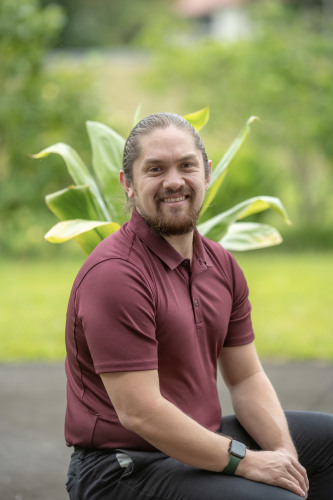
Kamalani Johnson
Biography
Dr. Kamalani M. F. H. Johnson is the Artemis A.W. and Martha Joukowsky Postdoctoral Fellow in Gender and Sexuality Studies at the Pembroke Center at Brown University. His research utilizes the archival recovery of nineteenth- and twentieth-century Hawaiian-language literature to develop the pūkuʻi concept—a methodology of intellectual binding and refusal. His current book project, Insurgent Archives: Intellectual Binding and Political Ontologies of Refusal, expands upon his dissertation to theorize how Kānaka Maoli intellectuals re-engineered media infrastructure to refuse the biopolitical assemblage of the U.S. Territorial period. He is particularly interested in how early twentieth-century print networks functioned as material kīpuka (safe havens) of relational sovereignty, examining how subaltern communities historically leveraged ancestral texts to resist state capture, settler-colonial pathologies, and state-centric paradigms of power. This theoretical intervention has been recognized by elite national bodies, securing the 2026 Law and Humanities Junior Scholar Award, the 2026 Biography Prize from the Center for Biographical Research (where he is the first political scientist in the prize's history to win), an appointment as a 2026 Fellow at the Institute for Critical Social Inquiry (ICSI) at The New School, and the American Political Science Association’s Diversity and Inclusion Advancing Research Grant for Indigenous Politics. His research on intellectual sovereignty, land intimacies, gender and sexuality, language revitalization, and biopolitics appears or is forthcoming in Hūlili, Journal of World Philosophies, American Quarterly, ADVA, and Biography, as well as edited volumes with University of Hawaiʻi Press and Bloomsbury Academic.
In Spring 2027, Johnson will teach the GNSS course Archival Sovereignties: Gender, Sexuality, and the Decolonial Record. In this course, students will examine how colonial archival architectures historically categorized, pathologized, and sought to eliminate Indigenous bodies and non-normative gender expressions. Utilizing decolonial pedagogies, students will investigate historical text-networks, oral histories, and insurgent community archives to analyze how marginalized groups weaponize print and media to safeguard ancestral data, practice community care, and construct counter-geographies. Over the course of the semester, students will gain hands-on knowledge of applied public humanities by interfacing with visual sovereignty methods and constructing their own localized public history or digital archiving initiatives.
Johnson holds a Ph.D. in Political Science (2026) with a focus on Indigenous Politics and Political Theory from the University of Hawaiʻi at Mānoa. He also holds an MA in Hawaiian Language and Literature (2022) and a BA in Hawaiian Studies and Linguistics from the University of Hawaiʻi at Hilo.